The choice between an ISO Tank vs Tank Truck depends on your supply chain’s geography and timeline. An ISO Tank is an intermodal container designed for international or long-haul domestic transport, allowing movement across ship, rail, and truck without transferring the actual liquid. A Tank Truck (or road tanker) is a dedicated vehicle designed for direct, fast, over-the-road domestic deliveries where intermodal transfer is unnecessary.
When supply chain executives evaluate an ISO Tank vs Tank Truck for liquid chemical freight, they are not merely selecting a container; they are designing a risk profile. In the hazardous materials sector, the equipment dictates the workflow, the potential points of failure, and ultimately, the financial exposure of the shipment.
Making the wrong choice can lead to excessive transloading costs, product degradation, and supply chain bottlenecks. To protect corporate margins and ensure operational continuity, leadership teams must understand the strategic differences between these two primary modes of bulk liquid transport.
ISO Tank vs Tank Truck: Core Operational Differences
While both vessels are designed to transport bulk liquids safely, their operational applications are fundamentally different.
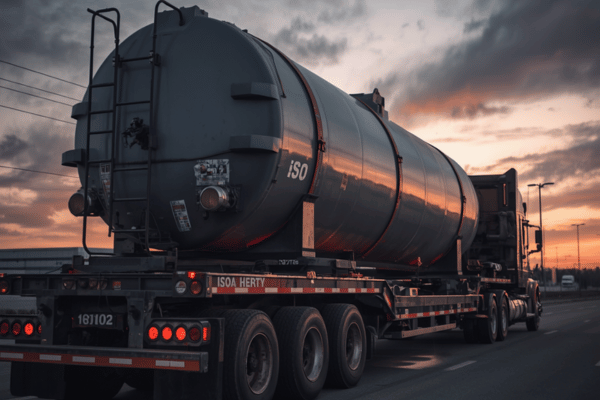
The ISO Tank: Intermodal Agility
An ISO tank is a cylindrical stainless steel pressure vessel mounted within a standard 20-foot frame. Its primary advantage is intermodal flexibility. An ISO tank can be loaded at a chemical plant in Houston, placed on a railcar, transferred to an ocean vessel, and delivered to a facility in Europe or Asia—all without the chemical product ever leaving the original tank.
By eliminating the need to pump hazardous materials from one vessel to another (transloading), ISO tanks drastically reduce the risk of spills, cross-contamination, and worker exposure. Furthermore, they can be utilized as temporary on-site storage solutions, acting as a buffer against supply chain volatility.
The Tank Truck: Direct Domestic Velocity
A tank truck is a specialized trailer permanently attached to a chassis, pulled by a road tractor. Its primary advantage is velocity and direct routing. For domestic, short-to-medium-haul shipments, the tank truck offers unmatched speed. There is no waiting for rail schedules or port terminal appointments; the truck leaves the loading facility and drives directly to the receiver.
Tank trucks are highly specialized, often featuring specific linings (like rubber or FRP) or multi-compartment designs that allow for the delivery of different chemical grades in a single trip. They are the backbone of “just-in-time” domestic manufacturing.
When to Deploy Each Asset
To optimize logistics spend, shippers must align the equipment with the specific demands of the route.
You should utilize an ISO Tank when:
- Crossing International Borders: Particularly for overseas export or deep cross-border rail into Mexico, where intermodal transfer is mandatory.
- Minimizing Handling Risk: If the chemical is highly reactive or toxic, eliminating transloading points protects the product and limits liability.
- Buffering Inventory: When receiving facilities lack available storage, an ISO tank can be staged securely on-site until the product is needed.
You should utilize a Tank Truck when:
- Speed is the Priority: For urgent, domestic shipments where rail or ocean transit would cause unacceptable delays.
- Executing Regional Distribution: Moving high volumes of product between regional refineries, plants, and distribution centers (e.g., within the Texas/Louisiana Gulf Coast corridor).
- Minimizing Demurrage: Tank trucks are loaded, driven, and unloaded quickly, avoiding the complex per-diem and chassis rental fees often associated with delayed ISO tanks.
ISO Tank vs Tank Truck: Making the Strategic Decision
Ultimately, the ISO Tank vs Tank Truck debate is a financial and risk-based calculation. Executives must weigh the linehaul cost of a direct truck against the lower transit costs (but longer transit times) of intermodal rail using an ISO tank.
Partnering with specialized chemical logistics providers eliminates the guesswork. Invia Global helps industrial shippers navigate this exact decision by analyzing product volatility, delivery timelines, and total landed costs. By leveraging deep expertise in both domestic over-the-road networks and international intermodal logistics, Invia Global ensures your freight is deployed in the exact equipment required to protect your product and your EBITDA.
Is an ISO tank safer than a tank truck?
Both are highly regulated and safe when managed by vetted carriers. However, ISO tanks offer a safety advantage for international or long-haul routes by eliminating the need to physically transfer (transload) the liquid between different modes of transport.
Can a tank truck be placed on a train or ship?
No. Tank trucks are designed exclusively for over-the-road transport. To move bulk liquids via rail or ocean, the product must either be pumped into a railcar/vessel or loaded into an intermodal ISO tank.
Which option is more cost-effective?
It depends on the lane. For long distances (over 700 miles) and international routes, ISO tanks utilizing rail or ocean networks are generally more cost-effective. For short regional hauls, tank trucks provide better cost-efficiency and faster turnaround times.